
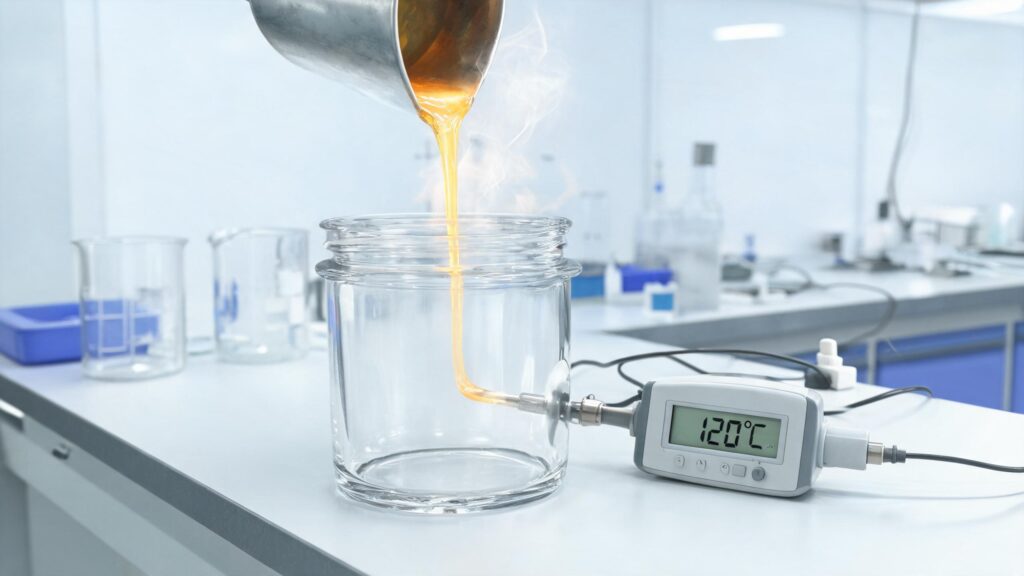
Thermal shock testing evaluates whether a glass container can withstand a sudden change in temperature without cracking or breaking.
For glass packaging such as candle jars, diffuser bottles, and other containers, thermal shock performance depends on several factors, including glass composition, annealing quality, container geometry, wall thickness distribution, surface condition, and the temperature differential used during testing.
This guide explains how thermal shock testing works, which standards are relevant to glass containers, what factors can affect performance, and what buyers should ask their glass supplier before approving production.
Quick Answer: What Is Thermal Shock Testing?
Thermal shock testing is a controlled test used to evaluate how well a glass container withstands a sudden temperature change.
A glass container may experience thermal stress when one part of the container becomes significantly hotter or colder than another part. Because glass expands and contracts with temperature, a rapid temperature difference can create internal stress and, in some cases, cause cracking or breakage.
For commercial glass containers, standardized thermal shock testing uses defined test conditions and evaluates whether the container survives the specified temperature change.
A practical pour test can also be useful during product development, but it should not automatically be treated as equivalent to a standardized laboratory thermal shock test.
Why Does Thermal Shock Matter for Glass Containers?
Glass is a rigid and brittle material. When different areas of a glass container experience different temperatures, they can expand or contract at different rates.
If the resulting thermal stress exceeds the container’s resistance, cracking or breakage may occur.
Thermal shock performance can be particularly important for applications involving:
- Hot filling
- Candle wax filling
- Heating and cooling cycles
- Rapid environmental temperature changes
- Commercial washing or processing
- Products exposed to repeated temperature changes
For candle jars, thermal performance should be evaluated together with the actual candle formulation, wick, fill temperature, container design, and intended use.
Common Situations That Can Cause Thermal Stress
| Situation | Why It Matters |
|---|---|
| Hot wax poured into a room-temperature candle jar | Creates a rapid temperature difference between the wax and the glass |
| A candle heats the inner wall during burning | Different areas of the container may reach different temperatures |
| Hot filling followed by rapid cooling | Creates a temperature gradient through the glass |
| Moving glass between significantly different environments | Rapid environmental changes can increase thermal stress |
| Washing or processing glass containers | Repeated heating and cooling can expose containers to thermal shock |
The actual temperature difference and failure risk depend on the container design, glass composition, heating or cooling rate, and other conditions. Therefore, a single temperature number should not be used as a universal pass/fail value for every glass container.
How Is Thermal Shock Testing Performed for Glass Containers?
Thermal shock testing can be performed using standardized laboratory methods or application-specific tests during product development.
1. Standardized Thermal Shock Testing
ASTM C149 is a test method for determining the relative thermal shock resistance of commercial glass containers such as bottles and jars. The method uses controlled hot and cold conditions and evaluates the container’s response to sudden temperature changes.
ISO 7459 is another relevant standard for determining thermal shock resistance and thermal shock endurance of glass containers. ISO states that ISO 7459 specifically covers glass containers and does not apply to laboratory glassware.
The exact test conditions should be selected according to the applicable standard and the intended application.
2. Practical Pour Testing for Candle Jars
For candle development, manufacturers and brands may also conduct application-specific pour tests.
A typical development process may include:
- Condition the glass container and wax to defined starting temperatures.
- Fill the wax according to the intended production process.
- Observe the container for visible cracking or damage.
- Inspect the jar after cooling.
- Compare results across different container designs or production batches.
A practical pour test is useful for product development, but it should be documented with defined test conditions and should not be presented as a substitute for a formal standardized test where a specific standard is required.
3. End-Use Candle Testing
A candle container should also be evaluated under its intended end-use conditions.
A burn test can help evaluate the combined effect of:
- Glass container design
- Wax formulation
- Wick selection
- Fill level
- Burn duration
- Container heating
- Surface decoration
Thermal shock testing and candle burn testing answer different questions, so they should not be treated as identical tests.
Relevant Standards for Glass Container Thermal Shock Testing
Several standards may be relevant depending on the glass container and its intended application.
| Standard | Relevance |
|---|---|
| ASTM C149 | Test method for thermal shock resistance of commercial glass containers such as bottles and jars |
| ISO 7459 | Test methods for thermal shock resistance and thermal shock endurance of glass containers |
| ASTM F2179 | Specification for annealed soda-lime-silicate glass containers produced for use as candle containers |
ASTM C149 covers the relative thermal shock resistance of commercial glass containers and includes controlled hot- and cold-bath testing procedures.
ISO 7459 specifically covers thermal shock resistance and thermal shock endurance testing for glass containers. The current ISO 7459:2004 edition was confirmed in 2022 and remains current.
ASTM F2179 is specifically designed for annealed soda-lime-silicate glass containers intended for use as candle containers. It covers minimum performance requirements and associated test methods, including annealing and thermal shock requirements.
Note: ISO 718 is intended for laboratory glassware rather than commercial annealed soda-lime-silicate glass containers, so it should not be presented as a primary standard for candle jars or general glass packaging.
What Factors Affect Thermal Shock Resistance?
Thermal shock performance is not determined by one specification alone.
1. Glass Composition
Different glass compositions have different thermal expansion characteristics.
For many commercial packaging applications, soda-lime-silicate glass is commonly used. Borosilicate glass has a lower coefficient of thermal expansion and can provide higher resistance to thermal shock in applications where its properties are appropriate.
However, the glass type alone does not guarantee the performance of a finished container.
2. Annealing Quality
Annealing is a controlled cooling process used after glass forming to reduce residual internal stress.
Poor or uneven annealing can leave residual stress in the glass and may reduce the container’s ability to withstand thermal or mechanical stresses.
For this reason, annealing quality is an important part of glass container manufacturing and quality control.
3. Wall and Base Thickness
Wall thickness can affect the thermal behavior and mechanical performance of a glass container, but thicker glass does not automatically mean better thermal shock resistance.
The thickness distribution is also important.
Areas such as:
- The base
- Corners
- Shoulder
- Side wall
- Rim
may respond differently to temperature changes.
For this reason, buyers should evaluate the actual container design and test results rather than approving a glass jar based only on a stated wall thickness.
4. Container Geometry
Container geometry can influence how heat is distributed through the glass.
Sharp transitions, uneven thickness, narrow sections, corners, and changes in wall geometry may create areas of higher stress.
A well-designed container should therefore be evaluated as a complete structure rather than based on one dimensional specification.
5. Surface Condition and Defects
Glass defects can affect mechanical performance.
Potential concerns include:
- Scratches
- Chips
- Surface damage
- Stones or inclusions
- Uneven surfaces
- Manufacturing defects
Quality inspection is therefore important before thermal testing and production approval.
6. Surface Decoration
Frosting, coating, printing, spraying, electroplating, and other decoration processes can change the surface characteristics of a glass container.
The final decorated container should therefore be evaluated when decoration is part of the finished product specification.
For custom glass packaging, testing only plain glass may not fully represent the final production condition.
7. Temperature Differential and Test Conditions
Thermal shock performance depends on the conditions used during testing.
Important parameters may include:
- Starting temperature
- Hot temperature
- Cold temperature
- Temperature differential
- Heating time
- Cooling time
- Transfer time
- Sample condition
- Number of samples
- Pass/fail criteria
A thermal shock result should therefore always be interpreted together with its test conditions.
Does Glass Thickness Determine Thermal Shock Resistance?
No. Wall thickness alone does not determine thermal shock resistance.
Thickness is one factor, but glass composition, annealing quality, geometry, thickness distribution, surface defects, and test conditions can all influence performance.
For example, a thicker container with poor annealing may perform worse than a properly annealed container with a different thickness.
For buyers, the better approach is to ask the glass manufacturer for the relevant test method, test conditions, sample information, and test results rather than relying on a single wall-thickness specification.
Thermal Shock Testing vs. Candle Burn Testing
Thermal shock testing and candle burn testing are related but different evaluations.
| Aspect | Thermal Shock Testing | Candle Burn Testing |
|---|---|---|
| Main purpose | Evaluate resistance to sudden temperature changes | Evaluate the container under actual candle-use conditions |
| Test conditions | Controlled temperature change | Candle, wax and wick used together |
| Main focus | Glass response to thermal shock | Overall product performance |
| Typical use | Quality control and container development | Candle product development and safety evaluation |
A candle jar that performs well in one test does not automatically guarantee the result of the other.
For candle brands, both the container and the finished candle system should be evaluated according to the intended application.
What Should Candle Brands Ask a Glass Supplier?
Before approving a new candle jar, buyers should ask the supplier questions such as:
- What glass composition is used?
- What thermal shock test method do you use?
- What temperature differential and test conditions are specified?
- How is annealing quality controlled?
- What are the wall and base thickness specifications?
- Are the final decorated samples tested?
- Can you provide relevant quality-control or test records?
- How are glass defects and residual stress inspected?
- Has the actual production design been tested rather than only a similar sample?
These questions can help buyers distinguish between a supplier that simply provides a glass container and a supplier with a documented quality-control process.
Practical Checklist Before Mass Production
Before approving a custom glass container for mass production, consider the following checklist:
Glass specification
- Glass composition defined
- Dimensions and capacity confirmed
- Wall and base thickness specified
- Container geometry reviewed
Manufacturing quality
- Annealing process controlled
- Glass defects inspected
- Dimensional tolerances checked
- Production samples evaluated
Testing
- Appropriate thermal shock test identified
- Test conditions documented
- Application-specific testing completed where appropriate
- Final decoration evaluated when applicable
Production approval
- Samples approved
- Quality requirements documented
- Production inspection requirements confirmed
- Pre-shipment inspection arranged
Frequently Asked Questions
What is thermal shock testing for glass containers?
Thermal shock testing evaluates how a glass container responds to a sudden change in temperature. The test uses defined conditions to determine whether the container develops cracks, fractures, or other failures.
What standards are used for thermal shock testing of glass containers?
ASTM C149 and ISO 7459 are relevant standards for thermal shock testing of commercial glass containers. ASTM F2179 is specifically applicable to annealed soda-lime-silicate glass containers produced for use as candle containers.
Does thicker glass always have better thermal shock resistance?
No. Thickness is only one factor. Glass composition, annealing, geometry, thickness distribution, surface condition, and test conditions also affect performance.
Is thermal shock testing the same as candle burn testing?
No. Thermal shock testing evaluates the response of glass to defined temperature changes, while candle burn testing evaluates the container as part of the complete candle system.
Can frosting, coating, or printing affect thermal shock performance?
Surface treatments can change the characteristics of the finished container. Therefore, when decoration is part of the final specification, the decorated production sample should be evaluated rather than relying only on tests of plain glass.
What should I ask a glass manufacturer before ordering candle jars?
Ask about the glass composition, annealing process, thermal shock test method, test conditions, dimensional specifications, quality-control procedures, and whether the actual production design has been tested.
Why Thermal Shock Testing Matters in Glass Packaging
Thermal shock resistance is one part of overall glass container quality.
For candle jars and other glass packaging, reliable performance depends on the combination of:
- Appropriate glass composition
- Proper annealing
- Sound container design
- Controlled manufacturing
- Surface quality
- Appropriate testing
- Consistent quality inspection
A supplier should therefore evaluate the finished glass container against the requirements of its intended application rather than relying on one specification alone.
Need Custom Glass Containers for Your Application?
Daystar Glassware supplies custom glass candle jars, diffuser bottles, perfume bottles, and other glass packaging for brands and packaging companies.
Our quality-control process covers glass forming, annealing, inspection, thermal shock evaluation, surface quality, and pre-shipment inspection according to the requirements of the product and application.
If you are developing a new glass container, share your dimensions, capacity, intended use, glass type, and decoration requirements with our team. We can help review the appropriate product and testing requirements before mass production.
[Request a Custom Glass Packaging Quote →]
About Daystar Glassware
Daystar Glassware is a glass packaging manufacturer specializing in custom candle jars, diffuser bottles, perfume bottles, and related glass packaging solutions.
Our services cover product development, mold creation, glass forming, surface decoration, quality inspection, and final packaging.
[Learn More About Our Quality Control →]
[Explore Custom Glass Packaging →]
txt
Pingback: Glass Decoration Methods Compared: 5 Techniques for Candle & Fragrance Brands
Pingback: How to Start a Private Label Candle Brand: Complete 2026 Guide
Pingback: Glass Packaging Cost & MOQ: The Complete 2026 Pricing Guide
Pingback: ASTM F2179 for Glass Candle Jars: Buyer’s Guide to Quality
Pingback: What Is Recycled Glass (PCR) Glass? 2026 Buyers Guide