
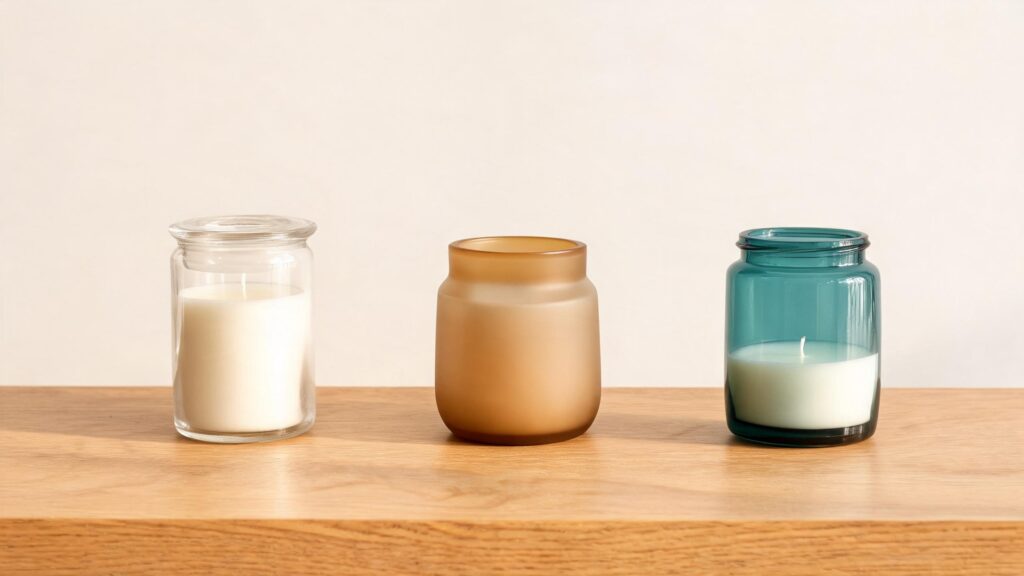
The glass container isn’t just packaging — it’s the single most important component of your candle product. It directly affects:
- Burn safety — Wrong glass can crack or shatter under heat
- Fragrance throw — Container shape influences how scent disperses
- Aesthetic appeal — The glass is what your customer sees and touches first
- Brand identity — Premium glass elevates perceived value
- Regulatory compliance — Many markets require heat-tested containers for candles
Choosing the wrong glass can mean product recalls, negative reviews, or worse — liability issues. This guide walks you through everything you need to know.
1. Glass Material: The Foundation
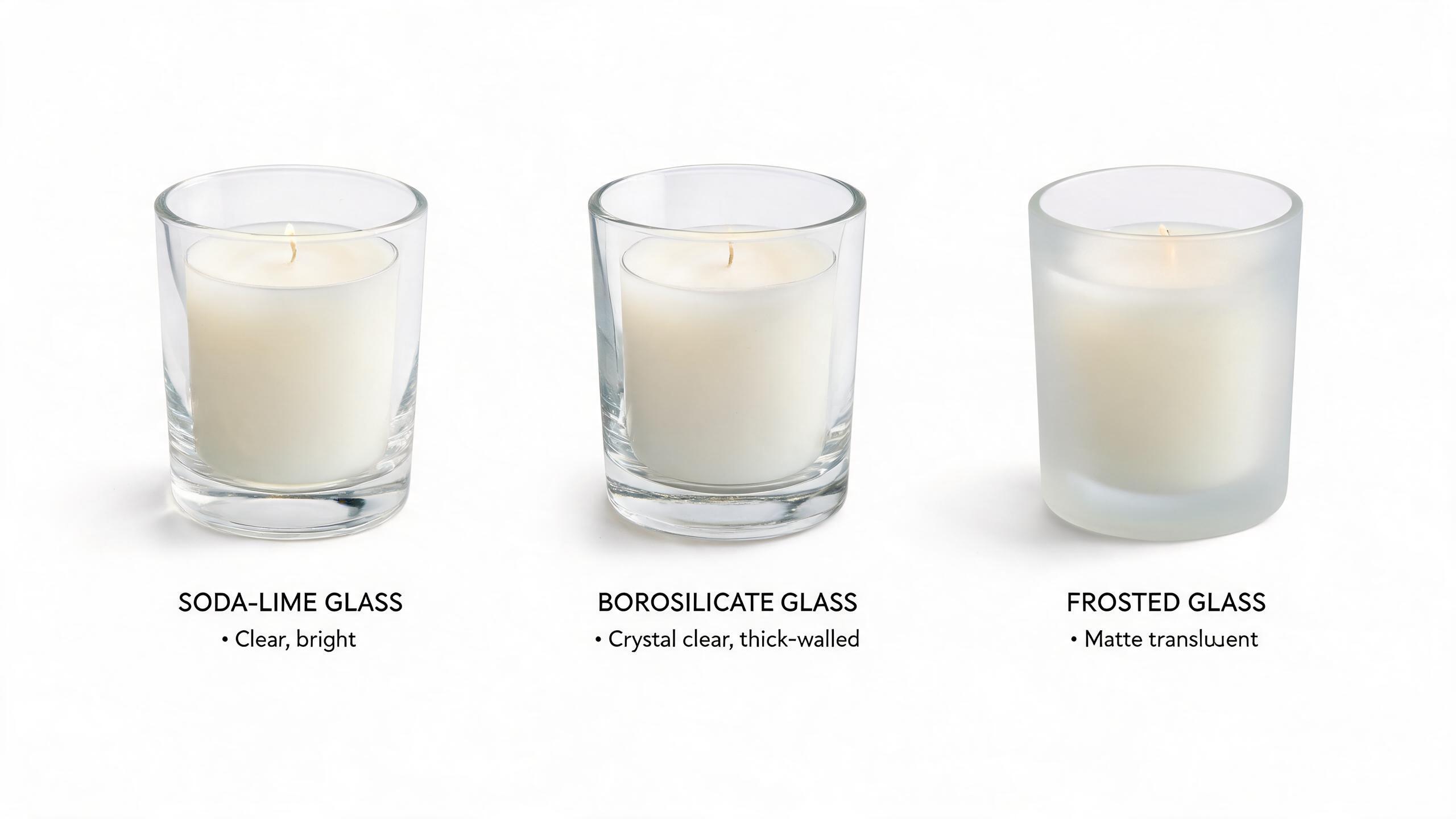
Not all glass is created equal. The two main types used in candle manufacturing are:
Soda-Lime Glass (Most Common)
This is the standard glass used in 90% of candle jars on the market.
Pros:
- Cost-effective for large production runs
- Easily molded into complex shapes
- Compatible with all decoration techniques (frosting, screen printing, hot stamping)
- Readily available in stock and custom designs
Cons:
- Lower thermal shock resistance than borosilicate
- Requires adequate wall thickness (3mm+ recommended)
- More sensitive to rapid temperature changes
Best for: Standard scented candles, container candles, mass-market brands, promotional candles.
Borosilicate Glass (Premium / Specialty)
A higher-grade glass with superior thermal properties, originally developed for laboratory use.
Pros:
- Exceptional heat resistance — won’t crack under temperature swings
- Extremely durable and long-lasting
- Crystal-clear clarity that doesn’t yellow over time
- Withstands direct flame contact
Cons:
- 2–3x more expensive than soda-lime glass
- Limited stock shapes available (mostly cylindrical)
- Longer mold development time for custom shapes
Best for: Luxury candle brands, refillable candle systems, high-heat multi-wick candles, reusable containers.
| Feature | Soda-Lime Glass | Borosilicate Glass |
|---|---|---|
| Cost | $0.30–$1.50 / unit | $0.80–$4.00 / unit |
| Heat Resistance | Good (thickness-dependent) | Excellent |
| Clarity | Good | Superior |
| Customization | Highly flexible | Limited shapes |
| Thermal Shock | Moderate risk | Near-zero risk |
| MOQ for Custom | ~5,000–10,000 pcs | ~10,000–30,000 pcs |
2. Wall Thickness: Your Safety Margin
Wall thickness is the most overlooked — and most critical — technical specification when choosing a candle jar.
Why It Matters
When a candle burns, the wax pool can reach temperatures of 60°C–75°C (140°F–167°F) at the walls, and up to 90°C+ (194°F+) near the flame. Thin glass can’t handle this gradient — it expands unevenly and cracks.
Thickness Guidelines by Jar Size
| Jar Diameter | Minimum Thickness | Recommended |
|---|---|---|
| Under 6 cm (2.4″) | 2.0 mm | 2.5 mm |
| 6–8 cm (2.4″–3.1″) | 2.5 mm | 3.0 mm |
| 8–10 cm (3.1″–3.9″) | 3.0 mm | 3.5 mm |
| 10–12 cm (3.9″–4.7″) | 3.5 mm | 4.0 mm |
| Over 12 cm (4.7″) | 4.0 mm+ | 5.0 mm+ |
Pro tip: Multi-wick candles generate significantly more heat. Always increase wall thickness by at least 0.5–1.0 mm for 2+ wick configurations.
Red Flags to Watch For
When sourcing glass jars, check for:
- Uneven wall distribution (thicker bottom, thinner sides is common in cheap molds)
- Bubble inclusions near the base — stress concentrators that can cause cracking
- Micro-cracks from poor annealing (visible under polarized light)
A reputable manufacturer should provide thermal shock test reports and annealing certification for every batch.
3. Container Shape: More Than Aesthetics
The shape of your candle jar directly affects burn performance, fragrance throw, and user experience.
Straight-Sided Jars (Best-Seller)
The most popular and versatile candle container shape.
- Burn performance: Excellent — even heat distribution, minimal tunneling
- Fragrance throw: Very good — wide opening allows consistent scent release
- Production: Easy labeling, efficient filling, minimal wax waste
- Customization: Available with or without lids, various neck finishes
Recommended for: All candle types; especially soy wax, coconut wax, and paraffin blends.
Tumbler / Flared Jars
- Burn performance: Good, but wax pool reaches walls faster at top than bottom
- Fragrance throw: Excellent — wide top opening maximizes scent diffusion
- Aesthetic: Modern, elegant; popular in premium home décor
Recommended for: Medium to large candles, room-filling fragrance candles.
Apothecary / Square Jars
- Burn performance: Moderate — corners can create uneven burn if not designed with proper radius
- Fragrance throw: Good — but narrow neck versions may restrict scent
- Key specification: Corner radius should be no less than R8–R10 mm to prevent stress concentration and candle tunneling in corners
Recommended for: Vintage, apothecary look; popular for “clean” branding.
Votive / Tealight Containers
- Small, shallow containers for short burn times
- Wall thickness still matters — even small containers need 2.0mm minimum
- Best in borosilicate if they’ll be used inside another holder (trapped heat)
4. Glass Finishes: The Visual Identity
Glass finishes define your brand’s visual language. Here are the most common options:
Clear Glass (Transparent)
The standard choice. Shows wax color, allows customers to see the burn progress.
- Best pairing: Colored wax, decorative labels, layered fragrances
- Cost: Baseline pricing
- Perception: Clean, honest, everyday luxury
Frosted / Matte Glass
A semi-transparent, velvety finish achieved through acid-etching or sandblasting the glass surface.
- Best pairing: Minimalist branding, monochrome labels, organic/natural brands
- Cost: +10–20% over clear glass
- Perception: Premium, sophisticated, spa-quality
- Note: Frosting slightly reduces thermal conductivity — use slightly thicker walls
Colored Glass (Mass-Tinted)
Color is added during the glass melting process, creating uniform color throughout the wall.
- Best pairing: Clear or metallic labels, luxury positioning
- Cost: +15–30% over clear; requires larger MOQ
- Available colors: Amber, cobalt blue, emerald green, smoky grey, pink
- Note: Darker colors (amber, cobalt) provide natural UV protection for fragrances
Spray Coating
- Best pairing: Gradient effects, metallic finishes, seasonal collections
- Cost: +10–25% over clear
- Note: Requires adhesion testing to ensure coating won’t peel under candle heat
Electroplating / Metallic Finish
- Best pairing: High-end luxury brands, gift sets, holiday collections
- Cost: +20–40% over clear
- Limitation: Not recommended for areas with direct flame proximity
5. Choosing the Right Size & Dimensions
Your candle’s size determines jar dimensions. Here’s a practical sizing guide:
| Candle Weight | Typical Volume | Jar Height | Jar Diameter | Burn Time (approx.) |
|---|---|---|---|---|
| 4 oz (113g) | 120 ml | 6–7 cm | 6–7 cm | 25–30 hours |
| 8 oz (227g) | 240 ml | 8–10 cm | 7–8 cm | 50–60 hours |
| 10 oz (283g) | 300 ml | 9–11 cm | 8–9 cm | 60–70 hours |
| 12 oz (340g) | 350 ml | 10–12 cm | 8–9 cm | 70–80 hours |
| 16 oz (454g) | 470 ml | 10–13 cm | 9–10 cm | 90–100 hours |
Key ratio: For optimal burn, the height-to-diameter ratio of your candle jar should be roughly 1:0.8 to 1:1.2. Containers that are too tall and narrow cause tunneling; too wide and shallow cause excessive wax pool depth.
6. Neck Finish & Lid Compatibility
This is where a lot of brands trip up. The neck finish (the top rim of the jar) must be perfectly compatible with your chosen closure.
Common Neck Finishes
- Cork: No specific finish required; the most forgiving option
- Wooden lid: Requires a smooth, flat rim for flush fit
- Metal screw cap: Requires threaded neck (specify thread count and pitch)
- Glass lid: Requires precise ground-joint specifications
- Snap-fit plastic: Requires specific rim geometry
Critical advice: Never assume a “standard” jar will fit a “standard” lid. Always:
- Request physical samples of jar + lid together
- Test the fit with wax inside (wax adds weight that changes the seal)
- Confirm the closure’s heat tolerance (glue on wooden lids can melt)
7. Common Mistakes to Avoid
#1: Choosing by Price Alone
Cheap glass is expensive in the long run. One batch of low-quality jars that crack during burning can destroy your brand reputation. Always prioritize thermal testing over price.
#2: Ignoring Thermal Shock Testing
Every glass jar intended for candle use should pass these tests:
- Pour test: Pour 80°C wax into room-temperature glass — no cracking
- Burn test: Full burn cycle, 4-hour increments — no cracking, no discoloration
- Thermal cycling: 3 complete burn cycles — structural integrity maintained
#3: Not Accounting for Wax Type
Different waxes heat differently:
- Soy wax: Burns cooler, more forgiving on glass
- Paraffin: Burns hotter, requires thicker walls
- Coconut wax: Very soft, needs container support
- Beeswax: Highest burn temperature, demands borosilicate or thick-walled soda-lime
#4: Skipping MOQ Discussions Early
Custom glass molds cost $800–$5,000 and require MOQs of 5,000–30,000 units. If you’re a startup, start with stock shapes and customize through decoration rather than mold-making.
#5: Neglecting the Unboxing Experience
Customers form an opinion about your candle before they ever light it. The weight, feel, and sound of the glass + lid combination creates the first impression. Lightweight, thin glass feels cheap — even with premium wax inside.
8. Custom vs. Stock: When to Invest
| Scenario | Recommendation |
|---|---|
| Startup, testing a new line | Stock jars + custom labels + unique lid |
| Established brand, signature shape | Custom mold (justify with volume) |
| Seasonal launches | Stock shapes with special finishes (colored glass, frosting) |
| Luxury positioning | Custom mold + premium glass + electroplating |
| Refillable/reusable strategy | Borosilicate custom mold (long-term value) |
9. Your Production Checklist
Before placing a glass jar order, confirm these points with your supplier:
- Glass material specified (soda-lime or borosilicate)
- Wall thickness specification for all points (top, middle, bottom)
- Thermal shock test certification
- Annealing certification
- Food-grade compliance (if applicable)
- ASTM / REACH / RoHS compliance for export markets
- Defect tolerance agreement (bubble size, scratch limits, color variation)
- Packaging specification for shipping (individual dividers, carton integrity)
- Sample approval process and lead time
- Production MOQ and scaling path
Final Thoughts
The right glass container turns a candle from a commodity into a branded experience. It’s the difference between a product that sits on a shelf and one that customers keep and reuse long after the wax is gone.
Take the time to test, sample, and iterate. Work with a manufacturer who understands candle-specific requirements — not just a general glass supplier. Your customers’ safety and your brand’s reputation depend on it.
About Daystar Glassware
Daystar Glassware is a professional glass packaging manufacturer specializing in custom candle jars, perfume bottles, diffuser bottles, and glass accessories. We offer:
- Full in-house mold development and production
- ASTM-tested, food-grade glass with thermal shock certification
- Custom finishes: frosting, colored glass, electroplating, screen printing, hot stamping
- MOQ as low as 5,000 pcs for custom projects
- Export to 50+ countries worldwide
Contact us to discuss your candle jar project — from sample to delivery, we’re with you every step.
View our complete collection for candle jars.
Recycled glass and candle jar materials
Recycled content is now a standard specification for many candle brands. Learn how PCR (post-consumer recycled) glass packaging works, what ratios are realistic for flint, amber, and green jars, and how it affects color, cost, and compliance.
Pingback: How to Start a Private Label Candle Brand: Complete 2026 Guide
Pingback: Glass Packaging Cost & MOQ: The Complete 2026 Pricing Guide
Pingback: What Is Recycled Glass (PCR) in Packaging? The Complete 2026 Buyer's Guide - Daystar Glassware