
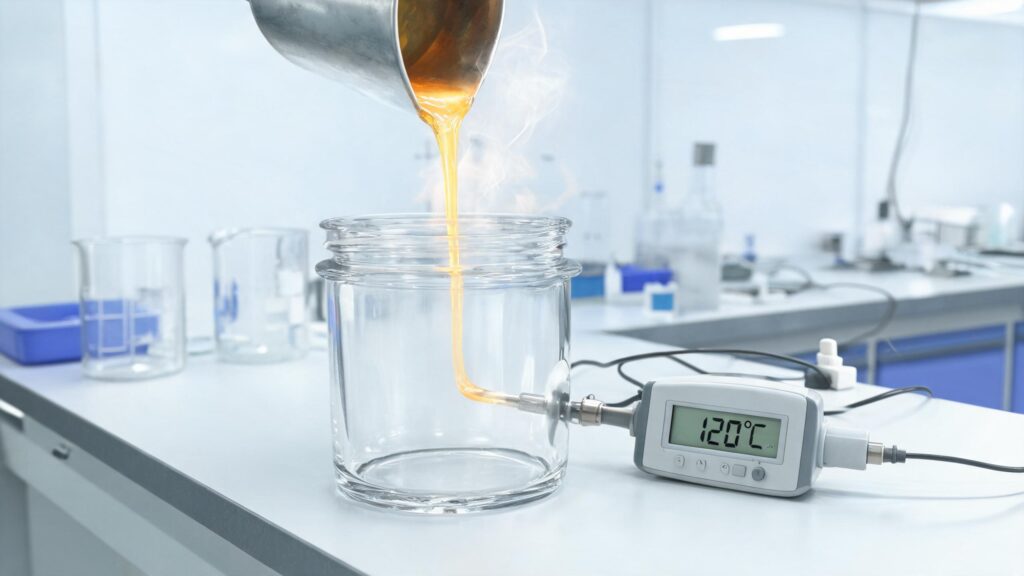
Thermal shock testing is a quality control process that evaluates a glass container’s ability to withstand sudden, extreme temperature changes without cracking, shattering, or structural failure. In practical terms: if you pour hot wax at 80°C into a room-temperature glass jar and it shatters — it failed thermal shock testing. If it stays intact — it passed.
For candle brands, fragrance companies, and cosmetic manufacturers, thermal shock resistance isn’t a “nice-to-have” — it’s a safety requirement. A shattered candle jar during burning can cause fires, injuries, product recalls, and lawsuits.
This guide explains everything you need to know: what thermal shock is, how it’s tested, what the industry standards are, and how to source glass containers that will never fail this test.
Why Does Thermal Shock Matter for Glass Containers?
Glass is a brittle material. Unlike metal or plastic, it doesn’t bend or flex when stressed — it breaks. Thermal shock occurs when different parts of a glass container experience different temperatures at the same time, causing uneven expansion and internal stress.
Here’s what happens inside a candle jar during use:
- A candle is lit, and the wax pool reaches 60–75°C (140–167°F) at the walls
- The flame vicinity can exceed 90°C (194°F)
- The bottom of the jar may remain at room temperature (especially on a cold surface)
- The temperature gap creates expansion in the hot zone while the cool zone stays the same size
- If the glass can’t handle this stress → crack
Common Scenarios Where Thermal Shock Happens
| Scenario | Temperature Change | Risk |
|---|---|---|
| Pouring hot wax (80°C) into cold jar (20°C) | Δ60°C | High |
| Candle burning on a cold marble countertop | Δ50°C+ | High |
| Moving a burning candle from indoors to outdoors (winter) | Δ40°C+ | High |
| Filling hot liquid into refrigerated glass bottle | Δ50°C+ | High |
| Dishwasher → cold rinse cycle | Δ40°C+ | Moderate |
| Shipping in unheated cargo → warm warehouse | Δ30°C+ | Moderate |
How Is Thermal Shock Testing Performed?
Method 1: Thermal Shock Resistance Test (ASTM C149 / ISO 7459)
This is the most common industrial test. The procedure:
- Heat the glass container in a hot water bath or oven to a target temperature (commonly 80–85°C for candle jars)
- Hold the temperature for at least 15 minutes to ensure uniform heating
- Rapidly transfer the container into a cold water bath at a specified lower temperature (commonly 20–25°C)
- Observe for cracks, fractures, or structural damage
- Repeat with incrementally larger temperature differentials to find the failure point
A passing result means the glass survived the ΔT without any damage. The larger the ΔT it survives, the better its thermal shock resistance.
Method 2: Pour Test (Practical Simulation)
- Glass jars are kept at room temperature (20–25°C)
- Wax is heated to pouring temperature (typically 75–85°C)
- Wax is poured directly into the jar
- The jar is observed for 24 hours for any cracks, especially at the base and corners
Method 3: Burn Cycle Test (End-Use Simulation)
- A full candle is produced in the jar (wax + wick)
- The candle is burned for 4-hour cycles (industry standard)
- After each cycle, the jar is inspected for cracks, discoloration, or deformation
- A minimum of 3 complete burn cycles is required
Industry Standards for Thermal Shock Testing
| Standard | Scope | Key Requirement |
|---|---|---|
| ASTM C149 | Thermal shock resistance of glass containers | Specifies ΔT thresholds and testing methodology |
| ISO 718 | Glass — thermal shock and thermal shock endurance | Defines laboratory test methods for all glass types |
| ISO 7459 | Glass containers — thermal shock resistance | Container-specific thermal endurance testing |
| ASTM F2179 | Annealed glass candle containers | Safety specification for candle glass containers |
| EN 1183 | Materials in contact with food — thermal shock | European food-contact glass standard |
For candle jars specifically, ASTM F2179 is the most relevant standard. It specifies minimum thermal shock resistance of Δ42°C and no cracks after thermal shock testing.
Thermal Shock vs. Thermal Stress: What’s the Difference?
| Aspect | Thermal Shock | Thermal Stress |
|---|---|---|
| Definition | Sudden failure from rapid, extreme temperature change | Cumulative damage from repeated moderate temperature cycling |
| Speed | Instant — cracks within seconds | Gradual — damage accumulates over time |
| Temperature Δ | Large (40–80°C+) | Moderate (15–30°C) |
| Example | Pouring 80°C wax into 20°C jar | Candle lit and extinguished daily for months |
| Failure mode | Catastrophic crack or shatter | Hairline cracks, crazing, weakening over time |
| Detection | Visible immediately | May take weeks or months to become visible |
A glass container that passes a thermal shock test may still fail from thermal stress fatigue after 50 burn cycles. Reputable manufacturers test for both.
What Affects Thermal Shock Resistance?
1. Glass Material
| Glass Type | Resistance | Typical ΔT Survival |
|---|---|---|
| Soda-Lime Glass (standard) | Moderate | Δ40–55°C |
| Soda-Lime Glass (thick-walled, 3.5mm+) | Good | Δ55–70°C |
| Borosilicate Glass | Excellent | Δ100–150°C+ |
2. Wall Thickness
- < 2.5mm: High failure risk — not recommended for candle use
- 2.5–3.0mm: Marginal — for small containers only (< 6cm diameter)
- 3.0–3.5mm: Good — suitable for standard candles
- 3.5mm+: Excellent — suitable for multi-wick and large candles
3. Annealing Quality
Annealing is the controlled cooling process after glass forming that eliminates internal stress. Poorly annealed glass contains residual stress that dramatically reduces thermal shock resistance. Ask your supplier for annealing certification — properly annealed glass viewed under a polariscope shows no stress patterns.
4. Container Design
- Rounded corners (R8–10mm minimum) reduce stress
- Even wall thickness from top to bottom is critical
- Flat, thick bases handle heat better than thin, curved bases
How to Ensure Your Glass Containers Pass Thermal Shock Testing
For Candle Brands & Manufacturers
- Request thermal shock test reports from your glass supplier — not just claims, but actual test data
- Specify your testing parameters in the purchase agreement
- Do your own pour test before approving production samples
- Burn-test 3 complete candles through their full life cycle before approving the final sample
- Audit your supplier — visit the factory and observe their annealing process and quality control
- Include ASTM F2179 compliance in your procurement specifications
Questions to Ask Your Supplier
- “What is the thermal shock resistance ΔT for this glass container?”
- “Can you provide thermal shock test certification for this batch?”
- “What glass material is used — soda-lime or borosilicate?”
- “What is the wall thickness at the top, middle, and base?”
- “Is this glass properly annealed? Can you show polariscope images?”
- “Do you test for thermal stress fatigue in addition to thermal shock?”
Real-World Example: Failed Thermal Shock Testing
A US candle brand ordered 10,000 straight-sided glass jars from a supplier who claimed “heat-resistant glass.” The jars were 2.0mm thick soda-lime glass. The brand did not perform their own pour test.
Result:
- During the first production run, 40% of jars cracked during wax pouring
- The remaining 60% showed micro-cracks after the first burn cycle
- Total loss: $12,000 in glass + $8,000 in wasted wax and labor
- Brand reputation damage: negative reviews from customers whose candles cracked at home
Lesson: A simple 5-minute pour test before production would have caught the problem and saved $20,000.
Frequently Asked Questions
What temperature difference can glass candle jars typically withstand?
Standard soda-lime glass candle jars with proper wall thickness (3mm+) can typically withstand Δ40–55°C. Thick-walled jars (3.5mm+) can handle Δ55–70°C. Borosilicate glass can handle Δ100°C+.
How do I perform a simple thermal shock test at home?
Heat your wax to pouring temperature (80°C). Keep the glass jar at room temperature. Pour the wax into the jar and observe for 5 minutes. If no cracks appear, the jar passed the basic pour test. For a more rigorous test: place the filled jar on a cold surface and observe for 30 minutes.
Is borosilicate glass worth the extra cost for candle jars?
For luxury, refillable, or multi-wick candles — yes. Borosilicate offers near-zero thermal shock risk. For standard single-wick candles in thick soda-lime glass, the cost premium is usually unnecessary if you source from a quality manufacturer.
Does frosting or coating affect thermal shock resistance?
Yes. Surface treatments like frosting and spray coating can slightly reduce thermal conductivity. Frosted jars should use slightly thicker walls (add 0.3–0.5mm) to compensate. Always thermal-shock-test decorated samples, not just plain glass.
Can thermal shock cause delayed cracking?
Yes. This is called “delayed fracture” or “static fatigue.” Micro-cracks from a near-failure thermal shock event can grow over time under repeated stress. A jar that survives pouring may crack on the third or fourth burn cycle. This is why burn cycle testing (minimum 3 cycles) is essential.
The Bottom Line
Thermal shock testing isn’t optional — it’s the difference between a safe product and a liability. For any brand using glass candle jars, perfume bottles, or diffuser containers, your quality control checklist should include:
- Thermal shock certification from your supplier
- Minimum 3mm wall thickness for soda-lime candle jars
- Annealing certification for every batch
- In-house pour test before production approval
- Complete burn cycle testing (3 cycles minimum)
About Daystar Glassware
Daystar Glassware is a professional glass packaging manufacturer specializing in custom candle jars, perfume bottles, diffuser bottles, and glass accessories.These ASTM standards are integrated into our comprehensive quality control system Every batch we produce undergoes:
- Thermal shock testing (Δ65°C+ standard for candle jars)
- Full annealing process with quality certification
- ASTM, REACH, and RoHS compliance
- Pre-shipment quality inspection
Pingback: Glass Decoration Methods Compared: 5 Techniques for Candle & Fragrance Brands
Pingback: How to Start a Private Label Candle Brand: Complete 2026 Guide
Pingback: Glass Packaging Cost & MOQ: The Complete 2026 Pricing Guide