
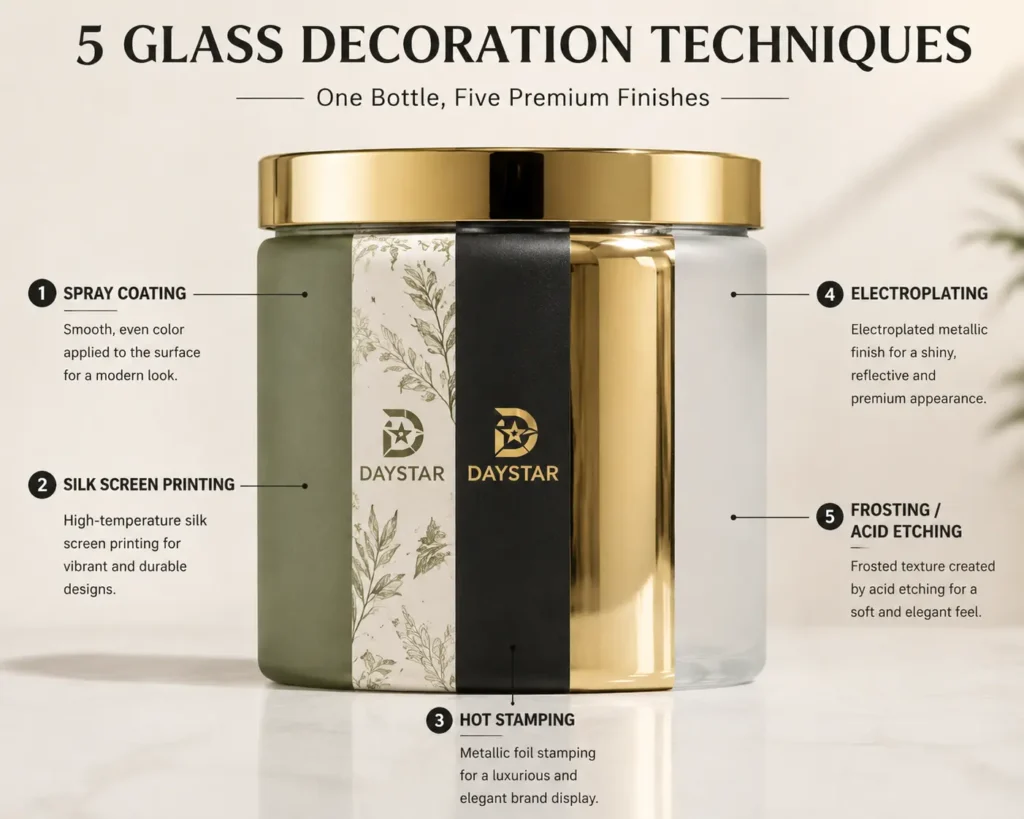
Glass Decoration Methods Compared: 5 Techniques for Candle & Fragrance Brands
The decoration on your glass packaging is what customers see, touch, and remember. A frosted amber diffuser bottle, a gold-stamped logo on a candle jar, a mirror-finish perfume bottle — each finish tells a different brand story.
But choosing the wrong decoration method can mean peeling labels after six months on shelf, faded colors under retail lighting, or a premium-looking finish that costs more than your margin allows. This guide compares the five most common glass decoration methods used in candle jar, diffuser bottle, and perfume bottle manufacturing — so you can choose the right one before you commit to a production run.
Quick Comparison: 5 Glass Decoration Methods at a Glance
| Method | Cost per Unit | Durability | Best For | Tooling Cost | Lead Time |
|---|---|---|---|---|---|
| Spray Coating | $0.05–$0.30 | Medium | Solid colors, gradients, opaque finishes | Low | 1–3 days |
| Silk Screen Printing | $0.03–$0.15 / color | High | Logos, text, patterns, multi-color designs | $50–$200 / color | 2–5 days |
| Hot Stamping | $0.10–$0.40 | Medium-High | Metallic logos, gold/silver accents, luxury branding | $100–$300 | 1–3 days |
| Electroplating | $0.20–$0.80 | Very High | Mirror finishes, full metallic coating, premium gift sets | $200–$600 | 3–7 days |
| Frosting / Acid Etching | $0.05–$0.20 | Permanent | Matte finish, privacy glass, minimalist aesthetics | Low | 1–2 days |
Key takeaway: Frosting is the only method that permanently alters the glass surface itself — it cannot peel or fade. All other methods apply a layer on top of the glass, so durability depends on adhesion quality and curing process.
Method 1: Spray Coating (Color Painting)
Cost: $0.05–$0.30/unit | Durability: Medium (3–5 years) | Heat Resistance: Up to 200°C
Spray coating applies colored paint or lacquer to the glass surface using spray guns, followed by low-temperature baking to cure the finish. It is the most versatile decoration method for achieving solid colors, gradients, and opaque finishes that are difficult to produce through glass-body coloring.
How It Works
- Glass surface is cleaned and degreased
- Primer coat applied (if required for adhesion)
- Color paint sprayed via automated or hand-held guns
- Glass baked at 150–180°C for 30–60 minutes to cure
- Optional top coat for UV or scratch protection
Pros & Cons
Pros: Unlimited color options (any Pantone match); gradient and ombré effects possible; relatively low setup cost; suitable for small and large batches.
Cons: Coating can scratch or chip if adhesion is poor; not dishwasher-safe in most cases; color consistency between batches requires tight quality control.
Best Use Cases
- Seasonal candle collections with trend colors
- Gradient-effect diffuser bottles
- Opaque perfume bottles that hide the liquid
- Brands wanting Pantone-accurate brand colors on glass
Quality check: Always request a cross-hatch adhesion test (ISO 2409) and a 72-hour salt spray test before approving a spray coating supplier. If paint flakes in either test, walk away.
Method 2: Silk Screen Printing
Cost: $0.03–$0.15/color/unit | Durability: High (5+ years) | Heat Resistance: Up to 250°C
Silk screen printing (also called screen printing) pushes ink through a mesh stencil onto the glass surface, then cures it at high temperature. It is the industry standard for applying logos, text, barcodes, and multi-color designs to glass packaging.
How It Works
- Design separated into individual color layers
- A mesh screen is created for each color (photographic emulsion process)
- Ink is forced through the mesh onto the glass using a squeegee
- Glass is baked at 200–250°C to fuse ink to the glass surface
- Process repeated for each additional color
Pros & Cons
Pros: Very durable after curing (resists scratching, washing, and heat); cost-effective at scale; crisp, precise edges; up to 6 colors possible.
Cons: Each color requires a separate screen ($50–$200 each); not suitable for photographic/gradient images; setup time increases with color count.
Best Use Cases
- Brand logos and product names on candle jars
- Ingredient lists and regulatory text on perfume bottles
- Decorative patterns and geometric designs
- High-volume production where per-unit cost matters
Cost tip: A 2-color logo on a 10,000-unit candle jar order costs roughly $0.06–$0.10 per unit including screen amortization. The same logo on a 1,000-unit order costs $0.15–$0.25 per unit because the screen cost is spread across fewer pieces. See our customization options for detailed MOQ guidance.
Method 3: Hot Stamping (Foil Stamping)
Cost: $0.10–$0.40/unit | Durability: Medium-High | Foil Types: Gold, silver, rose gold, holographic
Hot stamping uses a heated metal die to transfer a thin metallic foil onto the glass surface under pressure. The result is a shiny, metallic logo or accent that conveys luxury — the kind of finish you see on premium candle brands and high-end perfume bottles.
How It Works
- A custom metal die is engraved with your design
- Metallic foil (gold, silver, rose gold, or holographic) is positioned between the die and glass
- The heated die presses the foil onto the glass surface
- Heat and pressure bond the foil to the glass
- Excess foil is removed, leaving only the stamped design
Pros & Cons
Pros: True metallic shine that cannot be replicated by printing; instant luxury perception; works on both clear and colored glass; single-step process.
Cons: Limited to single-color metallic foils per pass; foil can scratch off with abrasion; die cost ($100–$300) makes it less economical for small runs; not suitable for large area coverage.
Best Use Cases
- Premium brand logos on luxury candle jars
- Gold or silver accent lines on perfume bottles
- Holiday and gift-set editions
- Brands positioned at the $30+ retail price point
Pro tip: Hot stamping works best on smooth, flat or gently curved surfaces. Avoid stamping near embossed areas or sharp curves — the foil will not transfer evenly and may peel at edges.
Method 4: Electroplating
Cost: $0.20–$0.80/unit | Durability: Very High (7+ years) | Finishes: Gold, silver, chrome, copper, rose gold
Electroplating deposits a thin layer of metal onto the glass surface through an electrochemical process. Unlike spray coating or foil stamping, electroplating creates a true metallic bond — resulting in a mirror-like finish that is exceptionally durable and resistant to wear.
How It Works
- Glass surface is silvered (coated with a conductive layer)
- The glass is immersed in an electrolyte solution containing metal ions
- An electric current causes metal ions to bond to the glass surface
- The glass is rinsed, dried, and optionally clear-coated for protection
- Full plating or selective plating (masking) is possible
Pros & Cons
Pros: Most durable metallic finish available; true mirror reflection; can cover entire bottle or selected areas; premium feel that elevates perceived value significantly.
Cons: Highest cost per unit; requires larger MOQ (typically 10,000+ pieces); longer production cycle; environmental regulations on plating waste; not recommended for areas in direct contact with candle flame.
Best Use Cases
- Luxury perfume bottles with full metallic finish
- Premium candle jar collections (outer surface only)
- Holiday gift sets requiring high-end presentation
- Brands competing in the luxury beauty segment
Daystar Glassware operates a dedicated electroplating production line for candle jar and fragrance bottle projects, allowing full or selective plating in gold, silver, chrome, and rose gold finishes.
Method 5: Frosting / Acid Etching
Cost: $0.05–$0.20/unit | Durability: Permanent (surface-level) | Lead Time: 1–2 days
Frosting (also called acid etching or sandblasting) creates a matte, translucent finish by chemically or mechanically roughening the glass surface. Unlike all other methods on this list, frosting physically alters the glass itself — meaning the finish is permanent and cannot peel, fade, or scratch off.
How It Works
Acid etching: The glass is dipped in or sprayed with a hydrofluoric acid solution that dissolves a microscopic layer of the surface, creating a uniform matte texture.
Sandblasting: Fine abrasive particles are blasted at the glass surface under high pressure, creating a frosted effect. Sandblasting allows for precise pattern masking.
Pros & Cons
Pros: Permanent finish that lasts the lifetime of the glass; soft, premium tactile feel; diffuses light beautifully; low cost; can be combined with other methods (e.g., frosted body + hot-stamped logo).
Cons: Cannot be reversed once applied; slightly reduces glass transparency; acid etching requires strict environmental controls; fingerprint-visible on matte surface.
Best Use Cases
- Spa-quality diffuser bottles and reed diffusers
- Minimalist candle jar brands
- Apothecary-style perfume bottles
- Brands targeting the natural/organic segment
How to Choose the Right Glass Decoration Method
Use this decision framework to match your brand requirements to the right decoration method:
| If your priority is… | Choose | Why |
|---|---|---|
| Lowest cost per unit | Silk Screen Printing | Lowest per-unit cost at scale, especially for 1-2 color logos |
| Maximum durability | Frosting or Electroplating | Frosting is permanent; electroplating creates a metallic bond |
| Luxury / premium positioning | Electroplating + Hot Stamping | Mirror finish + metallic logo = high-end perception |
| Exact brand color matching (Pantone) | Spray Coating | Only method that can match any Pantone color precisely |
| Gradient or ombré effects | Spray Coating | Only method that supports color transitions |
| Minimalist / natural aesthetic | Frosting | Soft matte finish aligns with clean, organic branding |
| Small batch / startup order | Frosting or Spray Coating | Lowest setup costs, no expensive tooling required |
| Multi-color detailed design | Silk Screen Printing | Supports up to 6 colors with precise registration |
Combination Strategies: Layering Decoration Methods
The most distinctive packaging often combines two or more decoration methods. Here are proven combinations used by successful fragrance and candle brands:
| Combination | Effect | Example |
|---|---|---|
| Frosting + Hot Stamping | Matte body with shiny metallic logo | Spa-brand diffuser bottle with gold logo |
| Spray Coating + Silk Screen | Colored body with printed brand text | Amber candle jar with white brand name |
| Electroplating + Frosting (selective) | Mirror body with frosted window | Luxury perfume bottle with visible liquid level |
| Spray Coating + Hot Stamping | Colored body with metallic accent | Black candle jar with rose-gold brand mark |
| Clear Glass + Silk Screen + Frosting (base only) | Transparent body, printed logo, frosted base | Premium candle jar hiding wax residue at base |
Budget tip: A frosting + hot stamping combination typically costs $0.15–$0.50 per unit — less than electroplating alone, while achieving a comparable luxury feel. This is the most cost-effective premium combination for brands entering the $25–$40 retail price tier.
Quality & Durability Testing
Regardless of which decoration method you choose, your supplier should provide documentation for the following tests:
| Test | Standard | What It Verifies |
|---|---|---|
| Cross-hatch adhesion | ISO 2409 / ASTM D3359 | Coating does not peel or flake |
| Salt spray resistance | ASTM B117 | Finish survives humid/salty shipping conditions |
| Thermal cycling | ASTM C149 | Decoration withstands temperature changes |
| Chemical resistance | ASTM D1308 | Finish resists perfume oils, alcohol, cleaning agents |
| UV aging | ASTM G154 | Colors do not fade under retail lighting |
At Daystar Glassware, every decorated batch undergoes 100% quality inspection covering adhesion, color accuracy, and surface integrity. Learn more about our thermal shock testing and quality standards.
Frequently Asked Questions
What is the cheapest glass decoration method?
Silk screen printing is the cheapest glass decoration method at scale, costing $0.03–$0.15 per color per unit for orders above 5,000 pieces. For small batches under 1,000 units, frosting is often more economical because it has no per-color tooling cost.
Which glass decoration method is most durable?
Frosting (acid etching) is the most durable glass decoration method because it permanently alters the glass surface rather than applying a coating. The finish cannot peel, fade, or scratch off. Electroplating is the most durable coating-based method, lasting 7+ years due to its metallic bond.
Can I combine multiple glass decoration methods on one bottle?
Yes, combining decoration methods is common and creates distinctive packaging. Popular combinations include frosting with hot stamping (matte body + metallic logo), spray coating with silk screening (colored body + printed text), and electroplating with selective frosting (mirror body + frosted window). Combination orders typically require MOQ of 5,000+ pieces.
What is the difference between spray coating and electroplating?
Spray coating applies colored paint to the glass surface and bakes it at 150–180°C, creating a finish that can eventually chip. Electroplating bonds actual metal ions to the glass through an electrochemical process, creating a mirror finish that is significantly more durable but 2–4x more expensive per unit.
Is hot stamping or silk screen printing better for a brand logo?
Hot stamping is better for luxury brands wanting a metallic gold or silver logo, while silk screen printing is better for multi-color logos and cost-sensitive production. Many premium brands use both: silk screen for the main label and hot stamping for the metallic brand mark.
Does frosting affect the strength of the glass?
No, frosting does not significantly affect glass strength. Acid etching removes only a microscopic surface layer (0.01–0.05mm), which is negligible compared to typical wall thickness of 2–4mm. Frosting is safe for all candle jar, diffuser, and perfume bottle applications.
What is the minimum order quantity (MOQ) for custom glass decoration?
The MOQ for custom glass decoration depends on the method. Frosting and spray coating have the lowest MOQ (typically 3,000 pieces). Silk screen printing requires 3,000–5,000 pieces per color. Electroplating typically requires 10,000+ pieces due to batch processing. Contact us for project-specific MOQ guidance.
Can glass decoration withstand candle burning temperatures?
Most glass decoration methods can withstand candle burning temperatures (60–90°C at the glass wall). Silk screen printing and frosting are fully heat-resistant. Spray coating and hot stamping should not be applied to areas in direct contact with the wax pool. Electroplating must never be used on the inner surface of a candle jar.
Conclusion: Match the Method to Your Brand
There is no single “best” glass decoration method — only the best method for your brand, budget, and product positioning. A startup candle brand may achieve maximum impact with frosting and a simple silk-screened logo. A luxury perfume house may require electroplating with selective hot stamping. The key is to match the decoration to your retail price point, production volume, and brand identity before committing to a production run.
When evaluating suppliers, always ask for physical samples of each decoration method, request adhesion and thermal test reports, and verify that the finish performs under real-world conditions — not just in a showroom.
About Daystar Glassware
Daystar Glassware is a professional glass packaging manufacturer specializing in custom candle jars, diffuser bottles, perfume bottles, and glass accessories. Our in-house capabilities include spray coating, silk screen printing, hot stamping, electroplating, and acid etching — all under one roof. With 10+ years of OEM/ODM experience and exports to 50+ countries, we help fragrance and candle brands create packaging that stands out on the shelf and survives the journey there.
Request a free quote — our team responds within 24 hours with decoration samples and pricing.
Browse our candle jar collection | Explore customization options
Pingback: How to Start a Private Label Candle Brand: Complete 2026 Guide
Pingback: Glass Packaging Cost & MOQ: The Complete 2026 Pricing Guide
Pingback: Shipping Glass Bottles & Jars from China: 2026 Freight Guide