
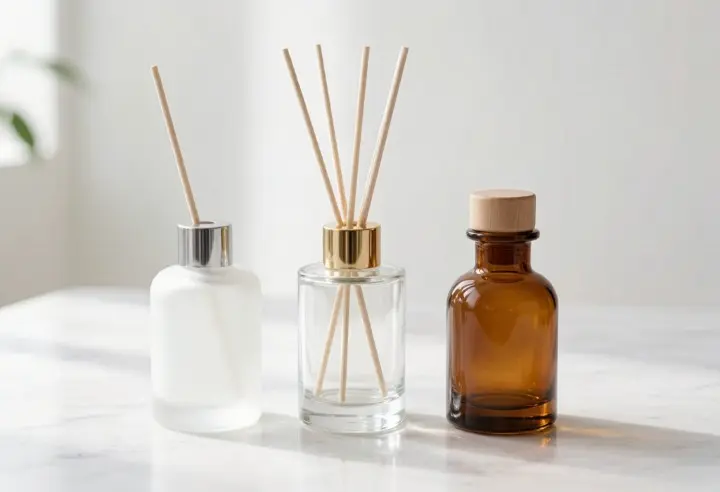
If you are launching a home fragrance brand — or expanding an existing product line — the reed diffuser bottle is one of the most important packaging decisions you will make. A well-designed glass diffuser bottle not only protects the fragrance oil but also defines how your product looks on a retail shelf, in a hotel lobby, or on a customer’s coffee table.
This guide covers everything a brand buyer needs to know about custom reed diffuser bottle manufacturing: from glass materials and neck finishes to decoration options, MOQs, and quality standards.
1. What Is a Reed Diffuser Bottle?
A reed diffuser bottle is a glass container designed to hold fragrance oil and a set of natural rattan or fiber reeds. The reeds absorb the oil and release scent into the air through capillary action — no heat, no flame, no electricity required.
Standard reed diffuser bottle capacities range from 50ml to 500ml, with 100ml and 200ml being the most popular sizes for retail.
2. Glass Material Options
The choice of glass directly affects clarity, durability, and cost:
| Glass Type | Characteristics | Best For |
|---|---|---|
| Soda-Lime Glass | Affordable, good clarity, standard choice | Mass-market brands, high-volume orders |
| High White (Extra-Flint) Glass | Superior clarity, fewer iron impurities | Premium/luxury brands, colored oils |
| Frosted Glass | Matte finish achieved through acid-etching or sandblasting | Minimalist, spa-style aesthetics |
| Colored Glass (Amber, Cobalt Blue, Green) | UV protection for fragrance oils | Natural/organic brands, light-sensitive formulas |
Pro tip: If your fragrance oil contains natural essential oils, amber or cobalt blue glass offers UV protection that extends shelf life by 30-50%.
3. Neck Finish and Closure Types
The neck finish is the diameter of the bottle opening — it determines which closure (cap, collar, stopper) fits.
| Neck Size | Common Uses | Reed Capacity |
|---|---|---|
| 18mm (GP 18/400) | Small bottles (50-100ml) | 4-6 reeds |
| 20mm (GP 20/410) | Standard bottles (100-200ml) | 6-8 reeds |
| 24mm (GP 24/410) | Large bottles (200-500ml) | 8-12 reeds |
Closure options include:
- Aluminum screw cap with plastic plug — most common, good seal
- Wooden stopper/cap — premium look, often used with luxury diffusers
- Silver/gold electroplated collar — high-end finish, matches perfume-grade packaging
- Plastic plug-only — for refill bottles, cost-efficient
4. Bottle Shapes and Design Trends
The shape of the diffuser bottle is a major brand differentiator. Current trends include:
- Round/cylindrical bottles — Classic, versatile, best surface for labeling and decoration
- Square and rectangular bottles — Modern, space-efficient for shipping, angular shelf presence
- Apothecary-style (round base, narrow neck) — Heritage/vintage aesthetic, popular with natural brands
- Geometric and faceted designs — Premium, light-refracting, Instagram-friendly
- Custom mold bottles — Fully unique shapes with your brand’s logo embossed in the glass
For brands on a budget, round bottles with custom decoration (frosting, screen printing, labeling) offer the best cost-to-aesthetic ratio. Custom mold bottles require a higher MOQ (typically 10,000-50,000 pcs) but deliver a completely unique product.
5. Decoration and Customization Options
A plain glass bottle becomes a branded product through decoration:
| Technique | Effect | Durability | Cost Level |
|---|---|---|---|
| Silk Screen Printing | Single or multi-color logos/designs, opaque ink | High, scratch-resistant | $$ |
| Hot Stamping | Metallic gold/silver foil logos | Medium, can fade with abrasion | $$ |
| Frosting / Acid-Etching | Matte, satin finish — partial or full coverage | Permanent (glass-level change) | $$ |
| Spray Coating | Solid color finish (matte, glossy, gradient) | High | $$$ |
| Electroplating | Metallic mirror finish (gold, silver, rose gold, chrome) | Medium-high | $$$ |
| Decal / Label Application | Full-color photographic designs | Depends on label material | $ |
| Embossing / Debossing | Raised or recessed logo in the glass mold itself | Permanent | $$$$ |
For reed diffuser bottles, a combination of frosting + silk screen printing is the most popular choice among mid-to-premium brands — it creates a soft, elegant feel at a reasonable cost.
6. MOQ and Pricing: What to Expect
| Production Type | Typical MOQ | Unit Price Range (100ml bottle) |
|---|---|---|
| Stock mold, no decoration | 3,000 pcs | $0.30-$0.60 USD |
| Stock mold, with silk screen | 3,000-5,000 pcs | $0.50-$1.00 USD |
| Stock mold, with frosting + decoration | 3,000-5,000 pcs | $0.80-$1.50 USD |
| Custom mold, full decoration | 10,000-50,000 pcs | $1.50-$3.00+ USD |
Pricing factors that affect unit cost: glass color (clear is cheapest; colored glass adds 15-30%), decoration layers, neck finish complexity, accessories included (cap, plug, collar), and packaging requirements.
7. Quality Testing Standards
Before placing a bulk order, ensure your manufacturer performs these tests:
| Test | Standard | What It Checks |
|---|---|---|
| Thermal Shock Resistance | ASTM C149 | Resistance to sudden temperature changes |
| Internal Pressure | ASTM C147 | Strength under pressure |
| Annealing Quality | Polariscope inspection | Proper stress relief in glass |
| Dimensional Tolerances | Caliper measurement | Neck size, height, diameter within spec |
| Leak Testing | Vacuum or pressure decay | Seal integrity with cap and plug |
| Chemical Compatibility | Immersion testing | Glass resistance to fragrance oil composition |
Always request a pre-production sample (PPS) before full production. This sample should include your exact decoration, color, and closure — not just a blank bottle from stock.
8. Freight and Logistics
- Ocean freight (FCL/LCL) — Most cost-effective for orders over 3-5 pallets. Transit time to US/EU: 25-40 days.
- Air freight — For urgent orders or samples. Cost is 5-8x ocean freight.
- Packaging — Bottles should be packed in partition cartons with dividers (not loose fill).
- Customs — Glass bottles have HS Code 7010.90. Duty rates vary by destination country.
Tip: Ask your manufacturer for DDP (Delivered Duty Paid) shipping if you want door-to-door delivery with all costs included in a single quote.
9. How to Choose a Reed Diffuser Bottle Manufacturer
- Glass source transparency — Where do they source raw glass? Do they have in-house furnace operations?
- In-house decoration capabilities — Can they do frosting, printing, and electroplating under one roof?
- Quality certifications — ISO 9001 minimum; ASTM testing reports available on request.
- Export experience — Do they regularly ship to your target market? Can they provide client references?
- Communication and samples — Is the sales team responsive in English? How fast can they produce a sample (target: 7-14 days)?
A manufacturer that handles glass melting, forming, annealing, and decoration in a single facility will almost always deliver better consistency, faster lead times, and lower total cost than one that subcontracts multiple processes.
Frequently Asked Questions
What sizes do reed diffuser bottles come in?
Standard capacities range from 50ml to 500ml, with 100ml and 200ml the most popular sizes for retail. Bottle size also determines reed count: an 18mm neck holds 4–6 reeds, a 20mm neck 6–8 reeds, and a 24mm neck 8–12 reeds.
What is the MOQ for custom reed diffuser bottles?
It depends on the production route. Stock molds without decoration start at 3,000 pcs per design; stock molds with silk screen printing or frosting plus decoration run 3,000–5,000 pcs. Fully custom molds with full decoration require 10,000–50,000 pcs.
How much do custom reed diffuser bottles cost per unit?
For a 100ml bottle, expect roughly $0.30–$0.60 for an undecorated stock mold, $0.50–$1.00 with silk screen printing, $0.80–$1.50 with frosting plus decoration, and $1.50–$3.00 or more for a fully custom molded and decorated bottle. Glass color, number of decoration steps, neck finish, accessories, and packaging all move the unit price.
Which glass should I choose for fragrance oils?
Soda-lime glass is the standard cost-effective choice for mass-market lines. Choose high white (extra-flint) glass for superior clarity with colored oils, and amber or cobalt blue for UV protection — this can extend shelf life by 30–50% when the formula contains natural essential oils.
What neck finish should I specify for my diffuser bottle?
18mm (GP 18/400) suits 50–100ml bottles with 4–6 reeds; 20mm (GP 20/410) is standard for 100–200ml with 6–8 reeds; 24mm (GP 24/410) is used for 200–500ml with 8–12 reeds. The neck finish must match your closure — aluminum screw cap, wooden stopper, electroplated collar, or a plug-only cap for refill bottles.
What quality tests should a diffuser bottle supplier perform?
Thermal shock resistance (ASTM C149), internal pressure strength (ASTM C147), annealing quality via polariscope inspection, dimensional tolerances for neck, height and diameter, leak testing with the cap and plug fitted, and chemical compatibility between the glass and the fragrance oil. Always approve a pre-production sample that includes your exact decoration, color, and closure — not a blank stock bottle.
Which decoration method is best for reed diffuser bottles?
Frosting combined with silk screen printing is the most popular choice for mid-to-premium brands: a soft, premium feel at reasonable cost. Hot stamping adds metallic gold or silver logos, electroplating creates mirror-like gold, silver, or rose gold finishes, and embossing or debossing places a permanent logo in the glass mold itself — which requires a custom mold.
10. Why Choose Daystar Glassware for Your Reed Diffuser Bottles
At Daystar Glassware, reed diffuser bottles are not a side product — they are one of our core manufacturing specialties. Here is what makes us different:
- Integrated production — Glass melting, automatic and semi-automatic forming lines, annealing lehrs, and decoration workshops all operate within our factory compound.
- Decoration expertise — In-house frosting, silk screen printing, spray coating and hot stamping, plus electroplating on a qualified partner line — enabling gold, silver, and rose gold metallic finishes.
- Stock and custom molds — We maintain dozens of stock molds for cylindrical, square, and apothecary-style bottles. Custom mold development is available with 30-45 day turnaround.
- Quality assurance — Every batch undergoes thermal shock testing (ASTM C149), polariscope inspection, dimensional measurement, and leak testing before shipment.
- Export experience — We ship regularly to the United States, Europe, Australia, and the Middle East. Our logistics team handles FCL, LCL, air freight, and DDP arrangements.
Whether you need 2,000 round frosted bottles with a silk-screen logo or 50,000 custom-mold geometric diffuser bottles with electroplated collars, we have the capability and experience to deliver.
Get Started
Ready to develop your custom reed diffuser bottle?
- Visit our Reed Diffuser Bottles Collection to browse stock designs
- Contact us to request a sample or discuss custom specifications
- Ask about our OEM/ODM process and get a quote within 48 hours
For the 50ml size specifically, see our 50ml round diffuser bottle page – six existing round moulds, 18 mm neck finishes, decoration options and MOQ 3,000 pcs.
Pingback: Glass Packaging Cost & MOQ: The Complete 2026 Pricing Guide
Pingback: Wholesale Glass Packaging & Bulk Orders | Daystar Glassware
Pingback: Shipping Glass Bottles & Jars from China: 2026 Freight Guide