
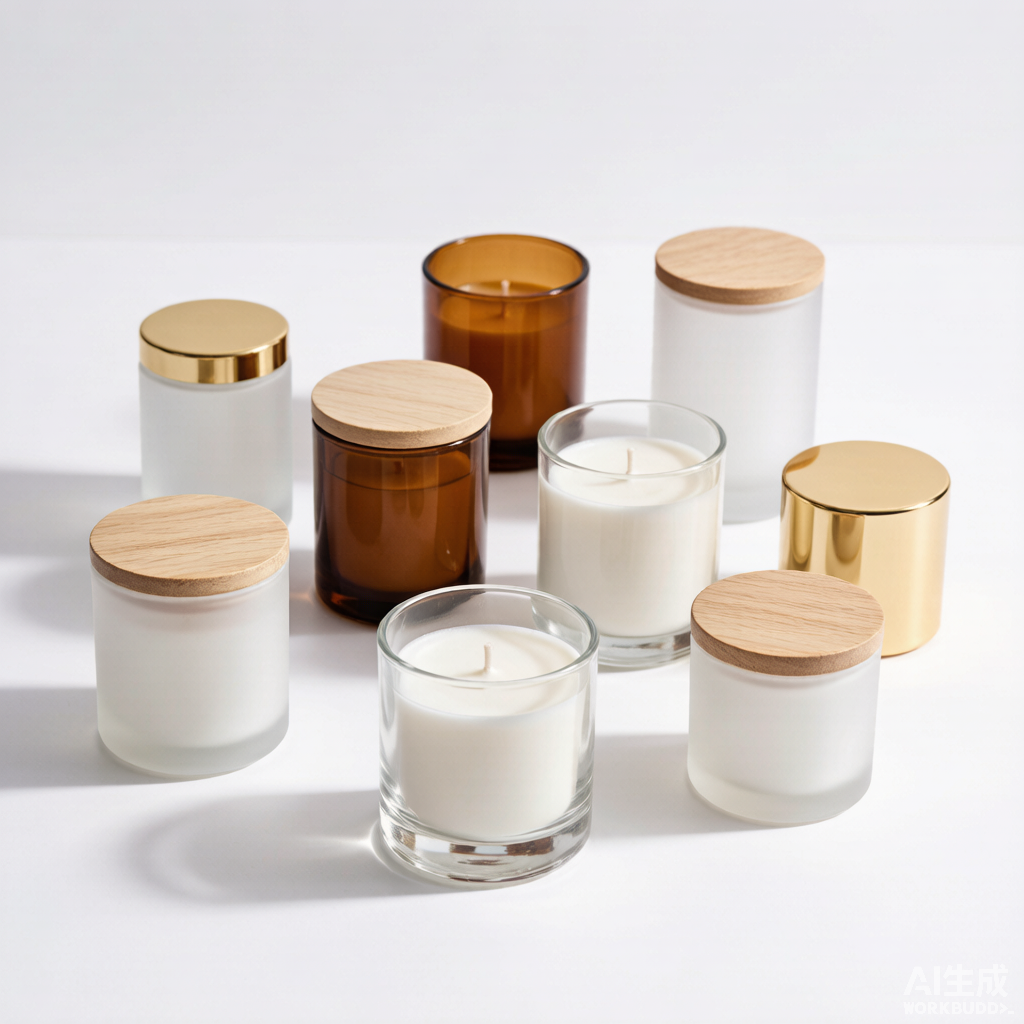
How to Start a Private Label Candle Brand: The Complete 2026 Guide
A private label candle brand is one of the lowest-barrier entries into the home fragrance market — but the difference between a brand that lasts and one that stalls at the first reorder comes down to how well you understand glass packaging.
The candle jar is the first thing your customer picks up, the centerpiece of your product photography, and the container that determines whether your candle burns safely. Yet most new brand owners spend 90% of their time on wax and fragrance, and treat the jar as an afterthought. That’s backwards.
This guide walks you through every decision point — from defining your concept to receiving your first production run — based on real glass manufacturing experience at Daystar Glassware, where we’ve produced over 10 million candle containers for brands in 50+ countries.
Step 1: Define Your Brand Positioning & Target Market
Before you choose a jar, you need to know who you’re selling to. Your target customer determines everything downstream — container material, size, decoration method, and price point.
| Market Segment | Price Range (Retail) | Container Type | Decoration | Typical MOQ |
|---|---|---|---|---|
| Mass Market / Gift Sets | $8–$15 | Standard clear glass, machine-made | Spray coating or label | 10,000–50,000 pcs |
| Mid-Tier Lifestyle Brands | $18–$35 | Colored or frosted glass, pressed | Silk screen + hot stamping | 5,000–10,000 pcs |
| Premium / Luxury | $40–$80+ | Crystal or hand-blown, custom mold | Electroplating + custom embossing | 3,000–5,000 pcs |
| Eco / Refillable | $25–$45 | Borosilicate, thick-wall | Frosting or minimal branding | 3,000–5,000 pcs |
Write down your retail price target before you start sourcing. It constrains every other decision and prevents you from over-engineering a jar you can’t sell profitably.
Step 2: Choose Your Glass Candle Container Material
The glass your candle burns in isn’t just packaging — it’s a safety-critical component. A jar that cracks under thermal stress can cause fires, product recalls, and liability claims.
There are three primary glass materials used for candle containers, each with different thermal resistance, clarity, and cost profiles:
| Material | Thermal Shock Resistance | Clarity | Cost (Relative) | Best For |
|---|---|---|---|---|
| Soda-Lime Glass | ~40°C ΔT | Good (high white) | Lowest | Mass-market candles, short burn time |
| High White Glass (Super Flint) | ~50–60°C ΔT | Excellent | Low–Medium | Most lifestyle brands (90% of market) |
| Borosilicate Glass | ~150°C+ ΔT | Clear / tinted | Medium–High | Refillable candles, long burn time, eco brands |
For a deeper dive into glass types and their thermal properties, see our guide on how to choose the right glass for candle making.
Why Thermal Shock Testing Matters
If your candle jar can’t withstand the temperature difference between a burning wick (up to 80°C inside) and a cool room (20°C), it will crack. This is tested using thermal shock resistance standards — the same ones used for laboratory glassware.
Reputable manufacturers provide thermal shock test reports. If yours doesn’t, that’s a red flag. Learn more in our thermal shock testing guide.
Step 3: Select Container Size & Shape
Candle container size affects burn time, fragrance load, and retail perception. Here’s how the most common sizes map to real-world use:
| Capacity | Burn Time | Typical Use | Popular Shapes |
|---|---|---|---|
| 3 oz (85 ml) | 15–20 hrs | Sample sets, gift packs, travel | Round, hexagonal |
| 7 oz (200 ml) | 35–45 hrs | Entry-level retail candle | Round, straight-sided |
| 10 oz (285 ml) | 50–65 hrs | Standard lifestyle candle | Round, tumbler, square |
| 14 oz (400 ml) | 65–80 hrs | Premium / large candle | Tumbler, cylinder |
| 18–20 oz (550–570 ml) | 80–100+ hrs | Luxury statement pieces | Cylinder, custom molds |
Shape Considerations
Straight-sided (tumbler) — The most popular shape. Easy to pour, stackable for shipping, and works with standard lids. Best for first-time brand owners.
Round (cylinder) — Classic and versatile. Slightly better for even burning since the wax pool forms symmetrically.
Square — Premium look but harder to pour evenly. Requires careful wick centering. Better for experienced brands.
Custom molds — If you want a shape nobody else has, expect to pay $1,500–$4,000 for mold development and commit to a 10,000+ piece MOQ.
Browse our candle jar collection to see standard shapes and sizes available with existing molds.
Step 4: Customize Your Packaging — Decoration Methods
This is where your brand identity lives. The decoration method you choose affects cost, durability, and how your product looks on a shelf next to competitors.
Five decoration methods are commonly used on glass candle containers:
| Method | Cost per Piece | Durability | Visual Effect | Best For |
|---|---|---|---|---|
| Spray Coating | $0.05–$0.15 | Medium (can scratch) | Solid color, opaque or gradient | Brand color matching, seasonal lines |
| Silk Screen Printing | $0.03–$0.08 | High | Logos, text, line art (1–3 colors) | Brand logos, ingredient labels |
| Hot Stamping (Foil) | $0.08–$0.20 | High | Metallic gold/silver finish | Luxury branding, premium lines |
| Electroplating | $0.15–$0.40 | Very high | Mirror-like metallic coating | Statement pieces, holiday collections |
| Frosting / Acid Etching | $0.03–$0.10 | Permanent | Matte, diffused light effect | Eco brands, minimalist aesthetic |
Most brands combine two or more methods — for example, a frosted jar with gold foil logo. For a detailed comparison of all five methods with cost breakdowns and quality testing standards, see our glass decoration methods comparison guide.
You can also explore our full OEM/ODM customization capabilities to understand what’s possible.
Step 5: Choose Your Closure (Lid or Cover)
The lid is not optional — it protects the candle from dust, preserves fragrance during storage, and completes the product’s visual identity. A missing or mismatched lid is one of the most common reasons for product returns.
| Lid Type | Material | Cost per Piece | Best For |
|---|---|---|---|
| Flat Metal Lid | Tinplate / aluminum | $0.10–$0.20 | Standard candles, cost-effective |
| Wooden Lid | Bamboo / pine / oak | $0.20–$0.50 | Eco brands, premium aesthetic |
| Dome Lid | Brass-plated metal | $0.25–$0.60 | Luxury candles, gift sets |
| Cork Stopper | Natural cork | $0.08–$0.15 | Rustic / artisanal brands |
| Custom Embossed Lid | Metal, custom mold | $0.40–$0.80 | Brand differentiation, exclusive lines |
Always order lid samples alongside jar samples. A 0.5mm tolerance difference between jar opening and lid diameter means the lid won’t fit — and you won’t know until production arrives.
Step 6: Understand MOQ & Cost Structure
MOQ (Minimum Order Quantity) is the single biggest source of confusion for new brand owners. Here’s what actually determines it:
Existing mold + standard decoration: 3,000–5,000 pcs. This is the entry point for most new brands. You pick a jar from the manufacturer’s catalog, add your logo via silk screen or hot stamping, and choose from standard lid options.
Existing mold + custom decoration (spray + multiple prints): 5,000–10,000 pcs. Custom colors require batch setup, so the MOQ goes up.
Custom mold (your own shape): 10,000–30,000 pcs. The mold cost ($1,500–$4,000) is amortized across the production run, so manufacturers require higher volume to justify the setup.
Full custom (mold + electroplating + custom lid): 15,000–50,000 pcs. This is luxury-tier production with multiple custom processes.
Cost Breakdown Example: 10 oz Candle Jar, 5,000 pcs
| Cost Component | Per Piece (USD) | Total (5,000 pcs) | Notes |
|---|---|---|---|
| Glass jar (high white, existing mold) | $0.45 | $2,250 | 10 oz tumbler, straight-sided |
| Silk screen logo (1 color) | $0.05 | $250 | Brand logo on front |
| Hot stamping (gold foil accent) | $0.12 | $600 | Brand name in gold |
| Wooden lid (bamboo) | $0.30 | $1,500 | Custom laser-engraved logo |
| Individual box (kraft paper) | $0.20 | $1,000 | With brand printing |
| QC & packaging labor | $0.08 | $400 | 100% inspection |
| Total landed (ex-works) | $1.20 | $6,000 | Before shipping & duties |
At a $28 retail price point, this gives you a gross margin of ~57% before marketing and distribution costs — healthy for a mid-tier candle brand.
Step 7: Find & Vet a Glass Manufacturer
Your manufacturer determines your product quality, lead times, and ultimately whether your brand survives its first year. The wrong partner delivers late, ships defects, and disappears when you need support.
Here’s a quick vetting checklist — for the full version with 25 evaluation points, see our glass manufacturer vetting checklist.
| # | Question to Ask | What a Good Answer Looks Like |
|---|---|---|
| 1 | Do you have your own factory or are you a trading company? | Own factory — can provide photos, videos, factory address |
| 2 | What quality certifications do you hold? | ISO 9001, FDA compliance, ASTM test reports |
| 3 | Can you provide thermal shock test results? | Yes, with specific ΔT values and test method references |
| 4 | What is your defect rate and how do you handle it? | Under 2%, with replacement or credit policy |
| 5 | Can I see samples before placing a full order? | Yes — free or at nominal cost, shipped within 5–7 days |
If a supplier can’t answer these five questions clearly, move on. There are hundreds of glass factories in China — the right one will be transparent from the first conversation.
Step 8: Quality Standards & Compliance
If you’re selling candles in the US or EU, your glass containers must meet specific safety standards. Non-compliant products can be seized at customs, recalled, or subject to liability claims.
Key Standards for Candle Containers
| Standard | Region | What It Covers |
|---|---|---|
| ASTM F2179 | USA | Standard specification for annealed soda-lime glass containers for candles |
| ASTM F2147 | USA | Test method for thermal shock resistance of glass containers |
| FDA 21 CFR Part 73 | USA | Color additives for glass in contact with products |
| EN 15426 | EU | Candles — soot behavior test (related to container design) |
For a comprehensive breakdown of ASTM standards for candle jars, read our ASTM glass candle jar buyer guide.
What Your Manufacturer Should Provide
Every production order should ship with:
- Thermal shock test report (batch-specific)
- Annealing certification
- Material composition analysis (lead/cadmium free)
- Dimensional inspection report
- FDA compliance declaration (if shipping to US)
If your supplier can’t provide these documents, you’re taking on uncompensated risk.
Step 9: Samples, Prototyping & Production Timeline
Never go straight to mass production. The sample phase catches problems that would otherwise cost you the entire order.
Typical Timeline
| Phase | Duration | What Happens |
|---|---|---|
| 1. Initial Samples | 5–7 days | Stock jars shipped for size/shape evaluation |
| 2. Decoration Samples | 10–15 days | Your logo applied to the chosen jar; color matching |
| 3. Pre-Production Sample (PPS) | 7–10 days | Final sample with all decorations, lid, and packaging — exactly as production will look |
| 4. Mass Production | 25–35 days | Full order production, QC, and packing |
| 5. Quality Inspection | 2–3 days | Third-party or in-house QC before shipment |
| 6. Shipping (sea freight) | 20–35 days | Port to port, depending on destination |
From first sample to delivery at your warehouse: 10–14 weeks total. Plan your launch date backward from this timeline.
Step 10: Shipping & Logistics
Glass is heavy and fragile. Your shipping strategy directly affects your landed cost and product integrity.
Key decisions:
- Sea freight vs. air freight: Sea is 5–10x cheaper but takes 3–5 weeks. Air is for urgent samples or small batches only — a full candle order by air will destroy your margins.
- Incoterms: FOB (Free on Board) is standard for first-time importers. You handle shipping from the port. DDP (Delivered Duty Paid) is simpler but costs 15–25% more.
- Pallets vs. cartons: Palletized shipments reduce breakage and speed up customs. Standard export pallets hold ~2,000–3,000 candle jars depending on size.
- Insurance: Always insure glass shipments. Breakage rate during transit is 1–3% even with good packing. Insurance costs 0.3–0.5% of cargo value.
For details on our shipping process and supported incoterms, visit our shipping information page.
Common Mistakes to Avoid
#1: Choosing a Jar Before Checking Burn Performance
A beautiful jar that causes tunneling or sooting will generate bad reviews faster than any other factor. Test your wax/fragrance/wick combination in the actual jar before committing to production.
#2: Skipping the Pre-Production Sample
The PPS is your last chance to catch errors. Skipping it to save 7 days can cost you a $6,000+ unusable production run. Never skip this step.
#3: Underestimating Lead Times
New brand owners routinely plan for 4 weeks and get 10. If you’re launching for Q4 holiday season, start sourcing in June — not September.
#4: Not Budgeting for Defects
Even with 100% QC, expect 1–2% breakage in transit and handling. Build this into your unit economics. If your margin can’t absorb a 2% loss, your price is too low.
#5: Ignoring Compliance Documentation
If you can’t produce ASTM test reports and FDA declarations on demand, retailers like Amazon, Target, and boutique chains will delist your product. Keep these documents on file for every SKU.
Frequently Asked Questions
How much does it cost to start a private label candle brand?
A private label candle brand typically requires $5,000–$15,000 in initial inventory for a 3,000–5,000 piece order with standard decoration, plus $500–$1,500 for samples and prototyping. Custom molds add $1,500–$4,000. Total startup cost including branding, packaging, and first production run usually falls between $8,000 and $20,000.
What is the minimum order quantity for private label candle jars?
The MOQ for private label candle jars starts at 3,000–5,000 pieces when using an existing mold with standard decoration (silk screen or hot stamping). Custom molds require 10,000–30,000 pieces. Electroplating or complex multi-process decoration raises the MOQ to 5,000–15,000 pieces.
Can I put my own logo on glass candle jars?
Yes. Logos can be applied via silk screen printing ($0.03–$0.08/pc), hot stamping foil ($0.08–$0.20/pc), or embossed directly into the glass mold ($1,500–$4,000 one-time mold cost). Silk screen is the most cost-effective for 1–3 color logos; hot stamping is best for metallic finishes.
How long does it take to manufacture custom candle jars?
From sample approval to finished goods, custom candle jar production takes 25–35 days for mass production, plus 10–15 days for decoration samples and 7–10 days for pre-production samples. Including sea freight shipping, the total timeline from first contact to delivery is 10–14 weeks.
Are glass candle jars safe for candles?
Glass candle jars are safe when they meet ASTM F2179 (annealed soda-lime glass) or equivalent thermal shock resistance standards. High white glass withstands temperature differentials of 50–60°C, while borosilicate glass handles 150°C+. Always request thermal shock test reports from your manufacturer.
What’s the difference between private label and white label candles?
Private label means the manufacturer produces containers to your specifications (custom shape, decoration, and branding), with MOQs starting at 3,000–5,000 pcs. White label means you buy existing stock jars and apply your own label — lower MOQ (as low as 500–1,000 pcs) but no customization of the container itself.
Can I get refillable candle jars for an eco brand?
Yes. Refillable candle jars are typically made from borosilicate glass or thick-walled high white glass with wider mouth openings (70–90mm) for easy refilling. MOQ is 3,000–5,000 pieces. Popular closure options include wooden lids and cork stoppers for an eco-friendly aesthetic.
Do I need FDA compliance for glass candle jars?
If selling in the US, glass candle jars must comply with FDA 21 CFR Part 73 (color additive safety) and ASTM F2179 (glass annealing standards). Your manufacturer should provide compliance documentation including material composition analysis confirming lead and cadmium content below regulatory limits.
The Bottom Line
Starting a private label candle brand is a systems problem, not a creative one. The brands that succeed aren’t the ones with the prettiest jars — they’re the ones that understood their supply chain, tested their containers properly, and built margins that survive real-world defect rates and shipping costs.
The ten steps in this guide are sequential — each decision constrains the next. Define your market, choose your material, lock your specs, vet your manufacturer, test your samples, and only then commit to production. Skip a step and you’ll pay for it later.
About Daystar Glassware
Daystar Glassware is a glass container manufacturer based in China with over 10 years of experience producing candle jars, diffuser bottles, and perfume bottles for brands in 50+ countries. Our capabilities include:
- In-house mold development and glass production
- High white, crystal, and borosilicate glass
- Full decoration: spray coating, silk screen, hot stamping, electroplating, frosting
- ASTM F2179 compliance and thermal shock testing
- MOQ from 3,000 pieces with existing molds
- 100% quality inspection before shipment
- Export to 50+ countries with full compliance documentation
Visit our candle jar collection to browse existing designs, or contact us to discuss your private label project. Ask about our OEM/ODM process and get a quote within 48 hours.