
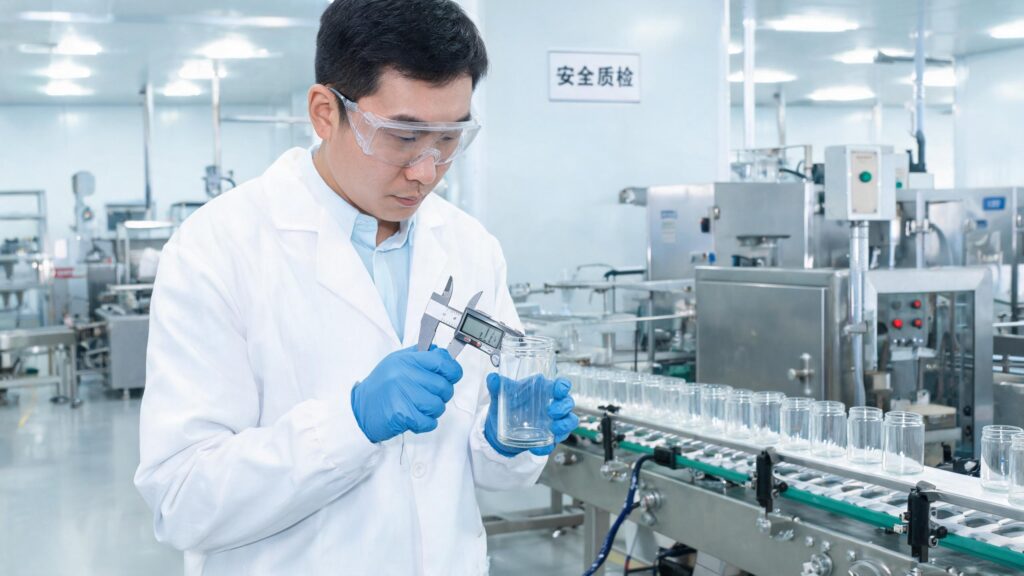
Finding a glass bottle manufacturer in China isn’t the hard part — there are thousands. The hard part is separating the reliable factories from the ones that will send you cracked jars, miss deadlines, or disappear after the first shipment.
After 10+ years in glass manufacturing, we’ve seen the full spectrum: factories that cut corners on annealing, trading companies posing as manufacturers, and suppliers who promise thermal shock resistance they’ve never tested. This guide gives you a repeatable process for evaluating any glass packaging supplier.
1. Verify They’re Actually a Manufacturer
This is step one, and the most common mistake. Many “glass bottle manufacturers” on Alibaba and trade platforms are actually trading companies with no factory.
How to verify:
- Ask for the business license — a genuine manufacturer’s license includes “生产” (production/manufacturing)
- Request a live video call from the factory floor — not a pre-recorded video
- Check if they have in-house mold making — manufacturers own their mold workshop
- Ask for the factory address and verify it on satellite imagery
Red flag: They can’t show you the factory floor live because “the Wi-Fi isn’t working.”
2. Check Their Quality Certifications
| Certification | What It Means |
|---|---|
| ASTM | Thermal shock, mechanical strength, container standards |
| REACH | EU chemical safety — required for fragrance, food, or skin contact |
| RoHS | No lead, mercury, cadmium in glass |
| FDA | Required for food-contact glass in the US market |
| SGS / Intertek | Independent third-party verification of factory claims |
| ISO 9001 | Quality management system and factory processes |
Verify: Request current certificate copies and cross-check the certificate number on the issuing body’s website.
3. Request Thermal Shock Testing Documentation
For candle jars, perfume bottles, and any glass experiencing temperature changes, thermal shock resistance is non-negotiable. Ask for test reports showing ΔT values. For candle jars: minimum Δ42°C per ASTM F2179. If they say “our glass is heat resistant” but can’t produce a test report — walk away.
4. Request Annealing Certification
Annealing eliminates internal stress from glass. Unannealed glass can crack weeks after production. Ask for polariscope images showing no stress patterns, batch-level annealing certification, and their lehr temperature curve. If they don’t know what a polariscope is — walk away.
5. Evaluate Their Sampling Process
Good sampling: 3D renderings before tooling, physical samples in 10–20 days, dimension inspection reports, questions about your intended use and fill temperature.
Red flags: Samples take 30+ days, look different from renderings, arrive without quality documentation, or they push you to approve quickly.
6. Investigate Mold-Making Capability
In-house CNC mold-making means better precision and timeline control. Standard mold development: 15–25 days. Complex: 25–35 days. Steel mold lifespan: 300,000–500,000+ cycles. Ask about multi-cavity capability and mold maintenance schedules.
7. Assess Their Quality Control System
A real QC system includes: incoming material inspection, in-process dimensional checks, AQL final sampling (Level II, AQL 2.5 or tighter), on-site testing equipment (calipers, thickness gauges, thermal shock baths, polariscopes), and batch inspection reports.
Ask: “What AQL level do you sample to?” “Can you show me a recent inspection report?” “What happens if a batch fails?”
8. Verify Production Capacity and Lead Times
Typical lead times: stock products 15–25 days, custom with existing mold 25–35 days, new mold 45–60 days. Ask about monthly capacity, number of production lines, and their largest single order fulfilled.
Red flag: A lead time significantly shorter than everyone else — they may be overpromising to get the order.
9. Check Packaging and Shipping Standards
Verify: individual glass dividers or foam inserts, export-grade cartons (5-ply minimum), pallets for container shipments, and loading photos before sealing. Agreed breakage rate: ≤1–2% for sea freight.
10. Evaluate Communication and Professionalism
Professional: Responds within 24 hours, answers technical questions directly, asks about your application details, provides documentation proactively.
Problem: Only talks about price, can’t answer technical questions, promises are vague, communication drops after challenging questions.
The 10-Point Quick Reference Checklist
- Manufacturer or trader? Verified factory license and live factory tour
- Certifications? Current ASTM / REACH / RoHS / FDA certificates, cross-checked
- Thermal shock tested? ΔT test reports with batch numbers and dates
- Properly annealed? Polariscope images, annealing certification
- Sampling professional? 3D renderings, physical samples with inspection reports
- In-house mold making? CNC equipment, standard 15–25 day lead time
- Real QC system? AQL sampling, on-site testing equipment, batch reports
- Production capacity? Verified line count, monthly output, realistic timelines
- Proper packaging? Individual dividers, export-grade cartons, loading docs
- Professional communication? Technical knowledge, transparency, responsive
What If You Can’t Visit the Factory?
- Video audit — Live walk-through of the factory floor via video call
- Third-party inspection — SGS, Intertek, or Bureau Veritas factory audit ($300–$800)
- Sample order first — Small trial order to evaluate product, packaging, and delivery
- Reference check — Ask for existing customer contacts in your region
Warning: Never place a large first order based on Alibaba reviews or glossy brochures alone. Verify with at least two methods above.
Frequently Asked Questions
How do I know if it’s a real factory or a trading company?
Request the business license and a live video walk-through. Traders cannot produce a real-time factory tour. In-house mold making is the clearest signal of a genuine manufacturer.
What’s the minimum order for testing a new supplier?
Most manufacturers offer 5–20 sample pieces for evaluation. For a production trial, minimum is typically 3,000–5,000 pieces using an existing mold. Start small, evaluate thoroughly, then scale.
How much does a third-party factory audit cost?
SGS, Intertek, or Bureau Veritas audits cost $300–$800 depending on scope and factory location. This is a small investment compared to the cost of a failed order.
What’s the biggest red flag?
Inability to produce thermal shock test reports and annealing certification. A factory that can’t prove basic quality testing should not receive your order.
How long should I test samples before approving?
At least 1–2 weeks. For candle jars: burn through 3 complete cycles. For perfume bottles: test spray pump compatibility, leaks, and chemical compatibility. Rushing sample approval is the most common cause of production problems.
About Daystar Glassware
Daystar Glassware is a direct glass packaging manufacturer based in Shenzhen, China. We invite every potential client to verify us against this checklist:
- Factory-direct manufacturing with in-house mold making
- ASTM, REACH, RoHS certified — certificates available on request
- Thermal shock testing at Δ65°C+ standard for all candle jars
- Annealing certification and polariscope verification for every batch
- Live video factory tours available anytime
- Export to 50+ countries with documented breakage rates below 1%
Get Started
Ready to develop your custom glass bottles?
- Visit our product list to browse our designs
- Contact us to request a sample or discuss custom specifications
- Ask about our OEM/ODM process and get a quote within 48 hours
Pingback: How to Start a Private Label Candle Brand: Complete 2026 Guide
Pingback: Glass Packaging Cost & MOQ: The Complete 2026 Pricing Guide
Pingback: What Is Recycled Glass (PCR) Glass? 2026 Buyers Guide
Pingback: Top 10 Candle Jar Manufacturers in China (2026 Guide)